
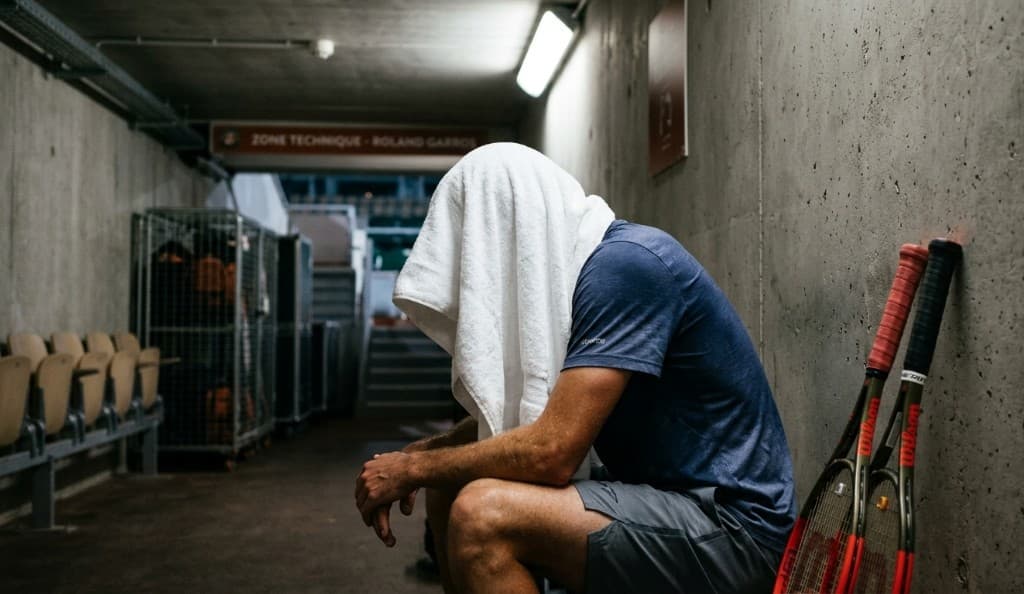
Fans have been conditioned by an era of unprecedented giants. When you watch legends hoist hardware week after week, it creates a massive collective blind spot. We start to view tournament victories as an expectation, a natural right for the top tier, and a baseline metric for success. But if you step away from the anomalies and look at the raw mechanics of a professional tennis tournament, the reality is far darker.
Winning a title on the professional tour is not normal. It is a statistical aberration. You may be ranked number 10 in the world, but the operational perspective and day-to-day outcomes of your career are diametrically opposite to the top two or three.
The 127-to-1 Reality
Unlike a league system where a bad night means dropping a few points in the standings, tennis is a ruthless mechanism of single elimination. A Grand Slam draw starts with 128 players. Over two weeks, the tournament operates as a systematic executioner's block, aggressively cutting the field in half every single round until only one man is left standing.
That means 127 of the best athletes on the planet will pack their bags and leave the city with a loss: a localized, athletic Squid Game where one misstep ends your life in the draw.
When you lock in a selection, you are asking a player to defy terrifying mathematical odds. To win a major, they must step onto the court and execute a flawless game plan seven consecutive times against increasingly lethal opposition. Even a standard ATP 250 event, requiring five straight wins, demands a sequence of sustained perfection that most touring professionals will only string together a handful of times in their entire careers.
The Outlier Excuse: Debunking the "Big Three" Myth
The standard, lazy excuse for this lack of diversity is well-worn: "The field hasn't stood a chance because the era was utterly monopolized by the Big Three, and now Sinner and Alcaraz are doing the exact same thing." It sounds logical on the surface, but it is exactly that: scratching the surface.
In the real world, gatekeeping is absolute. Over the last rolling five years, exactly five unique men have hoisted a major trophy. But let's look at a purely theoretical utopia where those giants never existed. Imagine that over the last five years, the tennis gods decreed absolute equality, forcing every single Grand Slam to go to a completely different, unique winner.
Over five years, that accounts for exactly 20 unique Grand Slam champions. If 20 completely different men won those trophies, how much of the field actually tastes glory? Out of the roughly 4,500 unique active professionals grinding globally across a five-year rolling window, that maximum-diversity utopia represents less than 0.5% of the touring pros.
The bottleneck isn't just Federer, Nadal, Djokovic, Sinner, or Alcaraz. The bottleneck is the sport itself. Scarcity is hardcoded into the DNA of tennis; the GOATs don't create the scarcity, they just help with the hoarding.
A Taste of the Real World
Entour leaderboard just provided a devastating masterclass in this structural reality. An overwhelming 80% of Entour users put their faith entirely in Jannik Sinner, backing what felt like an invincible, surefire ticket to a career slam for the champion and a fantasy slam for the user. Instead, his shocking early exit gave the majority of us a harsh, front-row seat to the unforgiving nature of professional tennis.
Now, as the draw fractures, the landscape of our fantasy league has completely shifted. The majority of remaining hopes are pinned squarely on Matteo Arnaldi to salvage the fortnight. Outside of that specific, surviving contingent, only a mere handful of users even have a mathematical hope left alive to score a fantasy slam. It is a striking parallel to the pro tour locker room itself: a massive field of hopefuls systematically reduced to a desperate few fighting for survival.
La victoire appartient aux plus tenaces
The bracket math only tells part of the story. Statistics cannot capture the compounding physical trauma of advancing. In a team sport, you can hide a minor injury behind your teammates or rely on the clock to run out. In tennis, there is no clock, no substitutions, and absolutely nowhere to hide.
Every match won is a heavy tax levied on the body. A grueling four-hour epic in the early rounds might look heroic on television, but in the locker room, it is recognized as a physical death sentence for the later stages. By the time a player reaches the deep end of a major, they are managing severe blisters, joint inflammation, and total neurological fatigue. The trophy is rarely handed to the man playing the most beautiful tennis; it is awarded to the man who can best tolerate the agony of his own physical decline. Victory truly belongs to the most tenacious.
The Takeaway
Entour provides a fantastic platform to feel like part of the inner circle, but it should never insulate us from the reality of the arena. Winning is rare. Survival is agonizing. When a surefire pick collapses or an entire league is forced to pivot to an underdog, it isn't just a fantasy setback. It is a potent reminder of the sport's core truth: the gauntlet is designed to destroy you, and lifting a trophy takes absolutely everything.